
Reddit’s Finest: 60 Best Puns That Broke the Internet
Reddit is the only place where a perfectly crafted pun can get you 10,000 upvotes or buried alive in the comments, and honestly there’s no...
Here’s something that might surprise you if you haven’t read Romeo and Juliet since high school: it’s absolutely stuffed with puns. Like, aggressively stuffed. We’re talking about a play where characters are cracking wordplay jokes while people are literally dying. Shakespeare wasn’t just a genius playwright. He was a comedy nerd who couldn’t resist a good double meaning, even (especially) at the worst possible moment.
The puns in Romeo and Juliet aren’t decorative. They’re structural. They tell you who characters are, what they’re feeling, and sometimes they foreshadow exactly how everything’s going to go horribly wrong. Shakespeare was clearly punishing his audience with the sheer volume of wordplay, but honestly? Four centuries later, we’re still talking about it, so it worked.
Let’s break down why this matters, how the puns actually function, and why a 16th century playwright’s dad jokes still hold up in 2026.
A pun exploits the fact that language is messy. Words sound like other words. Words mean multiple things. A pun grabs that ambiguity and makes you hold both meanings in your head at once. That’s where the humor (or the cleverness, or the gut punch) comes from.
There are a few flavors worth knowing about:
Homophonic puns use words that sound the same but mean different things. “Soles” and “souls,” for instance. (We’ll get to that one. Oh, we’ll get to that one.)
Homographic puns use a single word that has multiple meanings. “Grave” meaning both “serious” and “a hole in the ground where they put your body.” Same spelling, same pronunciation, wildly different implications.
Compound puns layer multiple wordplay elements into one phrase, so you’re juggling two or three double meanings simultaneously. Shakespeare loved these. He’d stack puns like a kid stacking blocks, except the blocks are made of language and the tower always lands on something devastating.
You knew this was coming. Mercutio gets stabbed by Tybalt, and as he’s dying, he says: “Ask for me tomorrow, and you shall find me a grave man.”
This is the pun that English teachers have been breathlessly explaining to bored teenagers for generations, and honestly? It deserves every bit of that attention. “Grave” means serious. “Grave” also means a burial plot. Mercutio knows he’s dying, and his response is to make the best pun of his life. That’s character work.
Think about what Shakespeare is doing here. He’s using a homographic pun (one word, two meanings) to accomplish about five things at once. It’s funny. It’s heartbreaking. It tells you that Mercutio is the kind of person who will joke until his literal last breath. It shifts the tone of the entire play from romantic comedy to tragedy. And it makes the audience laugh at the exact moment they should be horrified, which is an incredibly sophisticated emotional move.
Mercutio’s wit was so sharp it could really cut to the chase, even as he was being cut down. That’s not accidental. Shakespeare wrote a character whose identity IS wordplay, and then killed him, and the wordplay is how you know it’s real.
Before the Capulet feast (where Romeo will meet Juliet and ruin everyone’s lives), Romeo is moping around about Rosaline. Remember Rosaline? The woman Romeo was desperately in love with for approximately the first act? Yeah. Anyway, his friends are trying to get him to come to the party, and Romeo drops this:
“You have dancing shoes with nimble soles; I have a soul of lead.”
This is a homophonic pun. “Soles” (the bottom of shoes) and “souls” (the spiritual essence inside you). His friends are light on their feet. He’s weighed down by sadness. The pun makes the contrast physical. You can almost feel the heaviness.
And he’s not done. Right around the same time, he says: “Give me a torch: I am not for this ambling; being but heavy, I will bear the light.”
This one’s a compound pun, and it’s gorgeous. “Heavy” means sad, but it also means physically weighty. “Light” means the torch he’ll carry, but it also means the opposite of heavy (both in weight and in mood). “Bear the light” means carry the torch AND endure something easy. He’s saying: I’m too sad to dance, so I’ll just stand here holding a torch like a melancholy lamppost. But the language keeps folding in on itself, heavy and light trading places, and you get this sense of a guy who’s performing his own sadness. Which, tbh, is very Romeo.
There’s a temptation to think of Shakespeare’s puns as the Elizabethan equivalent of a comedian who can’t stop doing bits. And okay, there’s some of that. The man clearly loved wordplay the way some people love crossword puzzles. Compulsively.
But the puns in Romeo and Juliet serve real dramatic functions. Here are the big ones:
They establish character. Mercutio puns constantly because he’s brilliant, restless, and uses humor as armor. Romeo puns because he’s a romantic who sees double meanings everywhere (soles/souls, heavy/light). The servants in the opening scene pun crudely about “maidenheads” because they’re bawdy and looking for a fight. You can tell who someone is by how they pun.
They create dramatic irony. When Mercutio jokes about being a “grave man,” the audience laughs, but the laughter catches in their throat. The play’s ending is a dead serious affair, but the puns along the way were dead on target, pointing toward that ending the whole time. The wordplay keeps creating these little pockets where comedy and tragedy exist in the same breath.
They reflect the play’s obsession with duality. Romeo and Juliet is a play about opposites. Love and hate. Montague and Capulet. Light and dark. Life and death. Puns are inherently dualistic. Every pun holds two meanings at once, and that structural doubleness mirrors the play’s entire thematic architecture. (Sorry, that got a little English-professor-y. I’ll rein it in.)
They were crowd-pleasers. Let’s not be precious about this. Shakespeare was writing for a paying audience that included everyone from aristocrats to groundlings who’d throw stuff at the stage if they got bored. Puns were popular entertainment. They’re the fastest form of wit, the quickest way to get a reaction. Shakespeare always hit the mark with his audience, even when his characters were missing the mark entirely.
I’d be doing you a disservice if I didn’t mention that a huge number of puns in Romeo and Juliet are sexual. Like, a LOT of them. The play opens with Sampson and Gregory, two Capulet servants, making puns about “tool,” “naked weapon,” “maidenhead,” and “thrust.” It’s basically a locker room conversation in iambic pentameter.
Mercutio is even worse (better?). His Queen Mab speech goes to some places. His teasing of Romeo is relentlessly bawdy. When he talks about Romeo’s love suit for Rosaline not quite suiting him, there are layers there that a modern audience might miss but an Elizabethan audience absolutely would not. “Suit” meant courtship, a legal petition, AND clothing, and Mercutio is playing on all of them, usually with a sexual undertone that’s about as subtle as a brick.
This matters because it grounds the play. For all its soaring poetry about love and fate, Romeo and Juliet is also a play about bodies. Physical bodies that desire each other, fight each other, and die. The bawdy puns keep reminding you of that physicality. They won’t let the play float away into pure abstraction.
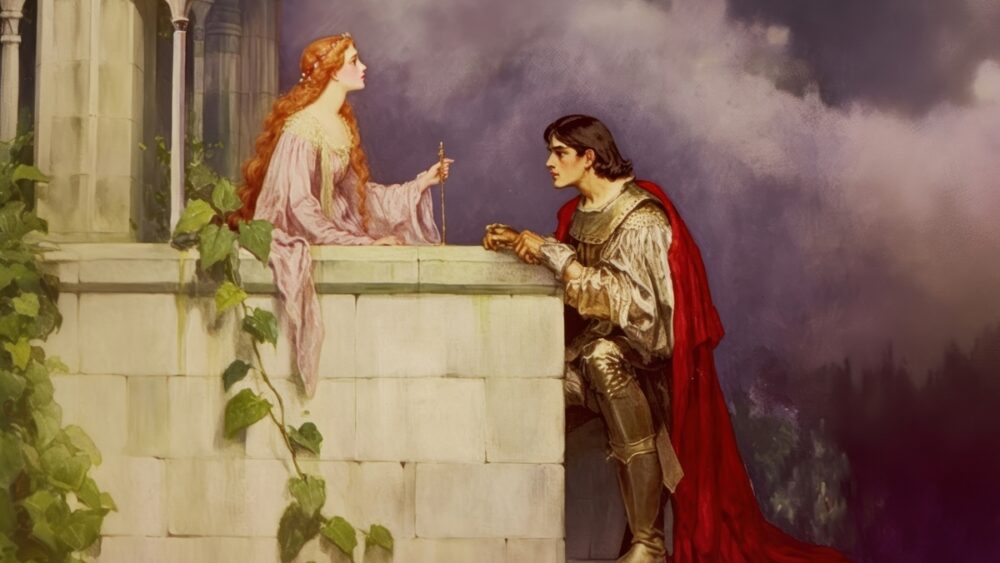
Juliet’s balcony scene is a real high point of the play (literally, she’s above him on the stage), and even here, the wordplay doesn’t stop. “What’s in a name? That which we call a rose by any other name would smell as sweet” isn’t technically a pun, but it’s an argument about the relationship between words and meaning, which is exactly what puns exploit.
And Romeo, climbing up to her, is constantly playing with light and dark, high and low, heaven and earth. The language keeps doubling. A pun by any other name would still be as rosy, especially in Verona, because this play can’t stop seeing two things in every word.
Even the concept of “star-crossed lovers” carries a kind of doubled weight. Their love is star-crossed (doomed by fate), but the language Shakespeare gives them is star-studded with wit and beauty. The play keeps handing you tragedy in one hand and brilliance in the other and asking you to hold both.
Here’s what separates Shakespeare’s puns from, say, your uncle’s puns at Thanksgiving. (No offense to your uncle.) The best puns in Romeo and Juliet aren’t just clever. They’re load-bearing. They carry emotional weight.
“A grave man” isn’t funny because “grave” has two meanings. It’s funny AND devastating because the two meanings collide at the exact moment a character is dying. The pun doesn’t exist for its own sake. It exists because language is failing, because Mercutio is facing something words can’t fix, and so he makes words do the only thing they can: mean two things at once.
A bad pun is one where the double meaning is the whole point. You hear it, you groan, you move on. A great pun is one where the double meaning reveals something. It opens a trapdoor under the sentence and you fall through into a deeper understanding of what’s happening.
Shakespeare’s puns in this play almost always fall into the second category. Even the dirty ones. Even the silly ones in the opening scene. They’re establishing that this is a world where words are slippery, where meaning is unstable, where two families with the same social standing can hate each other for no clear reason, and where two teenagers can say “I love you” and mean something that will literally kill them.
We live in the golden age of wordplay. Memes are puns. Tweet formats are puns. Half of TikTok comedy is built on double meanings and homophones. The pun never went away. it just changed platforms.
And the puns in Romeo and Juliet are kinda the blueprint. Shakespeare demonstrated that wordplay could be simultaneously funny and serious, that a joke could do narrative work, that the gap between two meanings of a word could be the most emotionally charged space in a sentence.
When you watch a comedian land a joke where the punchline recontextualizes everything that came before, they’re doing what Mercutio did. When a rapper uses a homophone to make a bar mean two things at once, they’re working in the same tradition. When a screenwriter gives a dying character a line that’s both a joke and a farewell, that’s the “grave man” move.
Shakespeare didn’t invent the pun. But he might have perfected the art of making it matter. Romeo and Juliet is the proof: 400-plus years later, we’re still unpacking the double meanings, still finding new layers, still laughing at “grave man” and then feeling a little terrible about it. Which is ngl exactly the reaction Shakespeare was going for.
Reddit is the only place where a perfectly crafted pun can get you 10,000 upvotes or buried alive in the comments, and honestly there’s no...
So You Want Examples of Puns. Let’s Talk About What You’re Actually Looking At. Here’s the thing about searching for examples of puns.
Sentences are weird if you think about them. Not just the grammar kind, the legal kind, the existential kind, the kind your mom texts you that’s...
Speed is the one topic where I physically cannot stop myself from making puns. It’s a problem. My friends have staged interventions.
Get the week's freshest puns, wordplay, and gloriously terrible jokes delivered straight to your inbox — no setup required.
By signing up, I agree to the Terms of Use and have reviewed the Privacy Policy.